Computing Machinery and Intelligence: A Visual Synthesis of Turing, 1950
A study companion to Phase 1, Week 1 — built around Alan Turing's 1950 paper Computing Machinery and Intelligence (Mind, Vol. 49), the paper that proposed the Imitation Game and reframed “Can machines think?” as an empirical test. Listen to the audio overview, page through the briefing deck, study the infographic, and read the synthesis below.
♪ Audio overview
▤ Briefing deck
◷ Infographic
✎ Written synthesis
In 1950, as the first room-sized electronic computers were still humming with the fragility of vacuum tubes and the novelty of their own existence, Alan M. Turing published “Computing Machinery and Intelligence” in the journal Mind. He began with a provocation that has since become the defining obsession of the twenty-first century: “Can machines think?” At a time when a “computer” was still often a job title for a human, Turing was already mapping the digital frontiers we now inhabit.
Our modern discourse regarding Artificial Intelligence—alternating between breathless hype over Large Language Models and existential dread—often suffers from a certain historical amnesia. We treat the emergence of “thinking” machines as a brand-new crisis of the 2020s, yet in doing so, we bypass the profound, counter-intuitive philosophy Turing established at the dawn of the silicon age. We are still playing catch-up to a man who saw the end of the game before most people even knew it had started.
To revisit Turing’s original 1950 text is to realize that many of our current debates over “sentience” or “consciousness” are exactly the kinds of linguistic traps he warned us to avoid. By looking past the famous “Imitation Game,” we can uncover five takeaways that remain shockingly radical, forcing us to reconsider our relationship with the machines we have created in our own image.
Takeaway 1: Defining “Thinking” is a Trap
Turing recognized that the greatest hurdle to understanding intelligence wasn't technical, but semantic. He argued that attempting to define “machine” and “think” by their common usage was a dead end—a distraction that led only to circular debates and subjective bias. To Turing, if we allow our definitions to be dictated by how the average person uses words, we aren't doing science; we are doing sociology.
He famously dismissed the idea that we should determine a machine’s capacity for thought through public opinion or abstract definitions:
“If the meaning of the words ‘machine’ and ‘think’ are to be found by examining how they are commonly used it is difficult to escape the conclusion that the meaning and the answer to the question, ‘Can machines think?’ is to be sought in a statistical survey such as a Gallup poll. But this is absurd.”
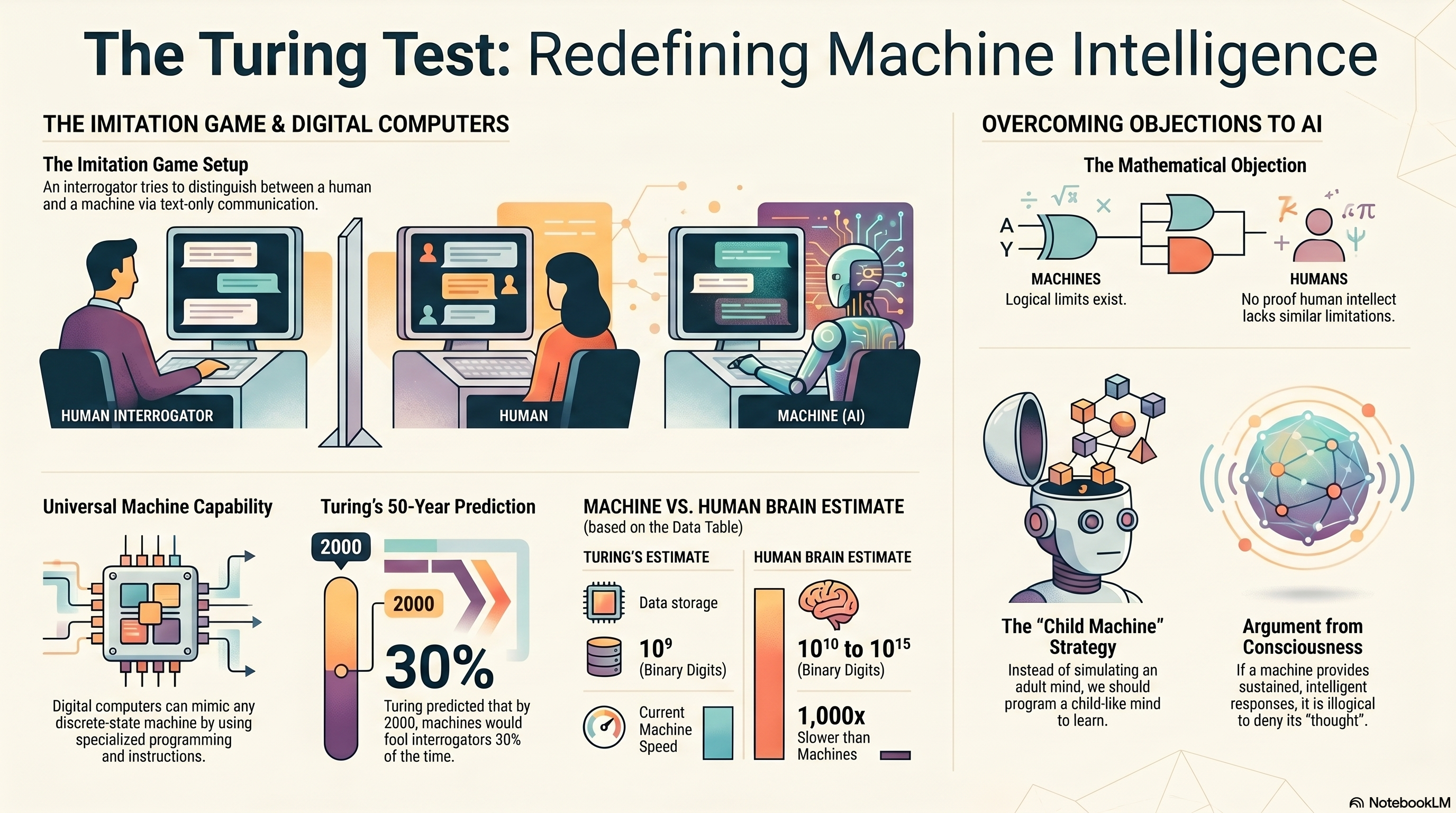
Instead of this “Gallup poll” approach, Turing proposed a radical shift toward behaviorism. He suggested that the internal “essence” of a mind is irrelevant to the observer. If a machine can imitate human output well enough to deceive an interrogator, then for all functional purposes, it is thinking. This is why Turing would likely find our modern obsession with “proving” whether an LLM “actually understands” to be a waste of time. For him, the performance is the proof.
Takeaway 2: The “Strawberries and Cream” Fallacy
One of the most persistent arguments against AI is what Turing called the “Argument from Various Disabilities.” It is the persistent belief that a machine may be able to calculate, but it will never be able to replicate the messy, beautiful complexities of human experience. Turing’s critics provided a long list of traits they believed machines could never possess:
- Be kind, resourceful, beautiful, or friendly.
- Have initiative or a sense of humour.
- Tell right from wrong or make mistakes.
- Fall in love or enjoy strawberries and cream.
Turing found the “strawberries and cream” example particularly illuminating. While it sounds frivolous, it highlights a deep-seated bias: we confuse specific biological functions with the universal capacity for intelligence. He argued that our skepticism is rooted in scientific induction—a logical error where we observe that the machines we have built so far are “ugly,” “limited,” and “designed for single tasks,” and wrongly conclude that these are necessary properties of all machines. We are like children who, having only ever met English speakers, assume it is “silly” to believe anyone could speak French. To Turing, “disabilities” like a lack of humor or empathy were not fundamental barriers; they were simply symptoms of a small storage capacity that would eventually be overcome.
Takeaway 3: We Should Build a Child, Not an Adult
Turing’s most prophetic insight was his rejection of the “top-down” approach to intelligence. Rather than trying to hard-code a finished “adult” mind—a feat of impossible complexity—he suggested we should program a “child” mind and then subject it to education.
Turing famously compared the child’s brain to a notebook purchased from a stationer’s. He viewed the mind not as a complex machine that must be pre-built, but as a system of “blank sheets” waiting for the mechanism to be written into them through experience.
“Presumably the child brain is something like a notebook as one buys it from the stationer's. Rather little mechanism, and lots of blank sheets... Our hope is that there is so little mechanism in the child brain that something like it can be easily programmed.”
In Turing’s view, “mechanism and writing are... almost synonymous.” The writing becomes the machine as the child learns. This evolutionary approach—identifying the “child machine” as hereditary material and “natural selection” as the experimenter’s judgment—directly anticipated the modern field of machine learning. Turing knew that we wouldn't build an intelligence; we would grow one.
Takeaway 4: The Universality of “Discrete-State” Machines
Turing’s confidence in the future of AI rested on the mathematical concept of the Universal Machine. He categorized digital computers as “discrete-state machines”—systems that move by sudden “clicks” from one definite state to another, much like a lighting switch or a clicking wheel that moves 120 degrees every second.
While he acknowledged that the human nervous system is “continuous” (not discrete), he argued that a digital computer could mimic the behavior of any system to a degree that makes the difference irrelevant to an observer. To prove this, he pointed to Charles Babbage’s Analytical Engine. Babbage’s nineteenth-century design was purely mechanical—made of wheels and cards rather than electrons and silicon. Yet, Turing noted that electricity is a “superficial similarity.” Because the logic of Babbage’s brass gears was equivalent to the logic of an electronic circuit, the physical “medium” of the machine didn't matter. The “thinking” isn't in the wires; it’s in the universal logic that can be ported from gears to vacuum tubes to silicon.
Takeaway 5: The “Wild Card” of Telepathy
Now, we must address the point where Turing’s paper takes a turn into the twilight zone. In a section that feels utterly bizarre to a modern reader, Turing addresses the “Argument from Extrasensory Perception (ESP).” He admitted that, by 1950, the statistical evidence for telepathy was “overwhelming” and that it presented a genuine “wild card” for his Imitation Game.
It is a fascinating, almost jarring moment of historical honesty. Turing worried that if a human “witness” could telepathically read the interrogator's mind to know which card they were holding, the machine (which lacked such powers) would be unmasked immediately. His practical, albeit weird, solution? Put the competitors in a “telepathy-proof room.” This section highlights the “Heads in the Sand” objection: even a titan of logic like Turing struggled to reconcile his scientific worldview with the paranormal “evidence” of his era. It serves as a humbling reminder that even the architect of AI was a man of his time, grappling with “ghosts and bogies” while building the future.
Conclusion: The Century-Old Question
Turing famously predicted that by the year 2000, we would speak of “machines thinking” without being contradicted. In the era of ChatGPT, we have reached that threshold. We debate the “souls” of chatbots and the “intentions” of algorithms daily, often using the very language Turing suggested we would.
Yet, his “Skin-of-an-Onion” analogy remains the most haunting part of his legacy. He suggested that when we look at the functions of the mind, we find mechanical operations we can explain away. We strip these away like layers of an onion skin, searching for the “real” mind underneath. But as we continue to peel back the layers of our own biology—replacing “intuition” with pattern recognition and “creativity” with generative statistics—we are forced to face a chilling possibility.
As we strip away these mechanical layers of the mind, is there a “real” soul at the center, or will we find that the onion is made entirely of skins, and the “mind” was the machine all along?