Why Software 2.0 Is Eating the World: The End of Programming as We Know It
A study companion to Phase 1, Week 4 — built around Andrej Karpathy's essay Software 2.0: the shift from hand-writing explicit logic to specifying neural-network architectures and letting optimization search the weights, where the dataset becomes the new source code. Listen to the audio overview, study the infographic, and read the synthesis below.
♪ Audio overview
▤ Briefing deck
◷ Infographic
✎ Written synthesis
Introduction: Beyond the "Toolbox" Misconception
There is a pervasive, almost dangerous misconception in our industry that neural networks are merely another tool in a machine learning engineer's kit—a specialized classifier to be used alongside SVMs or decision trees to win the occasional Kaggle competition. This perspective misses the forest for the trees. Neural networks are not just a new algorithm; they represent a fundamental shift in how we develop software. We are witnessing the birth of Software 2.0.
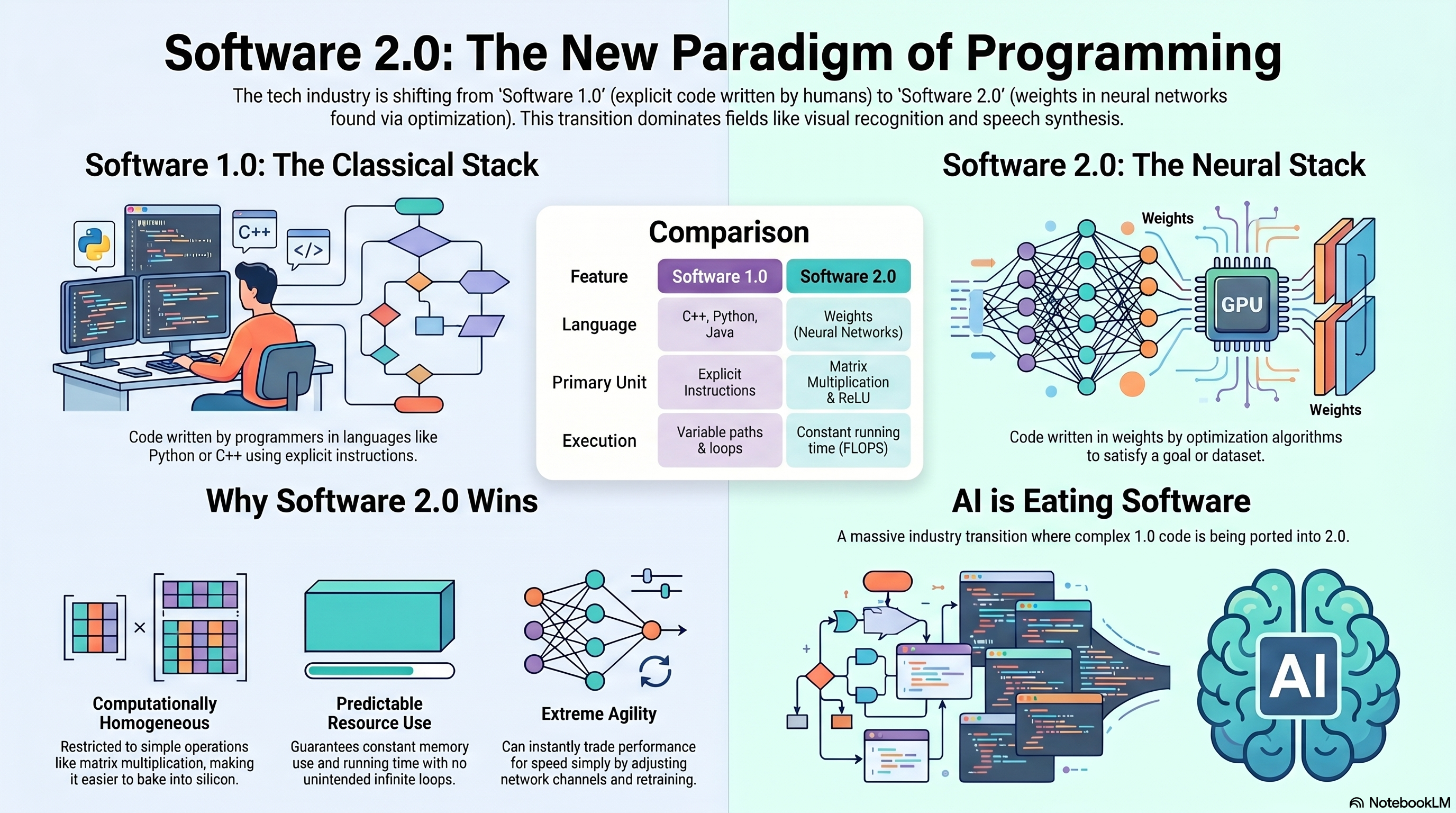
To understand this shift, we must first recognize the legacy constraints of Software 1.0. This is the "classical stack" we have spent decades perfecting, written in languages like Python or C++. It consists of explicit instructions written by a programmer. In this paradigm, a human identifies a specific point in program space with some desirable behavior and manually encodes the logic to reach it. However, we have reached the limits of what human-written logic can manage. Software 2.0 isn't just an upgrade; it is the obsolescence of the old guard.
Takeaway #1: We Are Moving from Writing Code to Searching for It
In the Software 1.0 era, programming was a point-wise exercise. You wrote a specific line of code to occupy a specific coordinate in the possibility space of programs. Software 2.0, however, is written in a much more abstract, human-unfriendly language: the weights of a neural network.
Instead of identifying a single point, we define a continuous subset of program space—a manifold—and use computational resources to search it. We provide a "rough skeleton" of the code (the neural network architecture) and then use Backpropagation and Stochastic Gradient Descent to navigate this manifold. This optimization search is surprisingly efficient, allowing the machine to fill in the millions of weights that no human could ever coordinate.
"and coding directly in weights is kind of hard (I tried)."
The transition is counter-intuitive: we are giving up the "exactness" of a single point for the statistical power of a continuous region. We provide the architecture; the optimization provides the solution.
Takeaway #2: The Dataset is the New Source Code
In the Software 2.0 paradigm, the definition of "active software development" has moved upstream. When training systems and network architectures become standardized commodities, the primary act of creation is no longer writing logic. Labeling is the new coding.
We are seeing a fundamental shift in the programming paradigm. The IDE of the future isn't VS Code or Vim; it is a data-labeling and curation platform. "Programming" now consists of curating, growing, massaging, and cleaning labeled datasets. This has split development teams into two distinct camps:
- 2.0 Programmers (Data Gardeners): These engineers "write" the program by editing the datasets that define the goal.
- 1.0 Programmers: A smaller, specialized group that maintains the training infrastructure, analytics, and labeling interfaces.
The daily life of a developer is evolving from a logic-builder into a data-gardener. We no longer iterate on a script; we iterate on the data that informs the manifold.
Takeaway #3: AI is Porting—and "Eating"—Traditional Software
Software (1.0) has been eating the world for decades, but now AI (Software 2.0) is eating software itself. We are seeing massive chunks of the 1.0 stack being ported into differentiable 2.0 code:
- Visual Recognition: We have moved from hand-engineered features to ConvNets where even the architectures are now being searched for by machines.
- Speech and Translation: Legacy Hidden Markov Models and phrase-based statistical techniques have been decimated. In their place are large ConvNets and WaveNets that produce raw audio signals.
- Games: While hand-coded Go programs existed for years, AlphaGo Zero—which transitioned from human data to self-play—became the strongest player in history by operating entirely within the 2.0 paradigm.
- Databases: Even core data management is being disrupted. Research such as "The Case for Learned Index Structures" shows that neural networks can replace B-Trees, outperforming them by up to 70% in speed while saving an order of magnitude in memory.
Google is already at the forefront of this, re-writing itself through projects like "One model to rule them all," which seeks to create a single model with a unified, amalgamated understanding of the world.
"Every time I fire a linguist, the performance of our speech recognition system goes up." — Fred Jelinek (1985)
Takeaway #4: The Surprising Efficiency of "Computational Homogeneity"
A production-level C++ codebase is a complex, heterogeneous sprawl of branching paths. In contrast, a Software 2.0 program is Computationally Homogeneous. It is essentially a "sandwich" of only two operations: matrix multiplication and thresholding at zero (ReLU).
This simplicity leads to several massive technical advantages:
- Simple to bake into silicon: Because the instruction set is so small, it is trivial to design custom ASICs and neuromorphic chips that execute these primitives with extreme efficiency.
- Constant running time: Every forward pass takes the exact same number of FLOPS. There is no branching logic, providing a level of predictability impossible in 1.0 codebases.
- Constant memory use: With no dynamic allocation, we eliminate memory leaks and the need to swap to disk.
- High Portability: A sequence of matrix multiplies is significantly easier to run across arbitrary hardware configurations than a complex classical binary.
From a Senior Research perspective, this predictability is a massive upgrade over the "sprawl" of legacy systems.
Takeaway #5: The Magic of "Agile" Performance Trade-offs
The "agility" of Software 2.0 provides a flexibility that feels like magic. In the 1.0 world, making a program run twice as fast is a "highly non-trivial" task involving months of manual refactoring and tuning.
In Software 2.0, you simply remove half the channels and retrain. The program will run exactly twice as fast, with a minor, predictable cost to performance. Conversely, if you gain access to more compute or a larger dataset, you can immediately improve the program's performance by adding channels. We are no longer constrained by the rigid logic of the programmer, but by the available compute and data.
Conclusion: Toward a Unified "Protobrain" Future
We are moving toward a world of pervasive, low-powered intelligence. We can already envision "protobrains"—inexpensive, specialized chips that integrate a pretrained ConvNet, a speech recognizer, and a WaveNet speech synthesis network onto a single piece of silicon. These protobrains will be attached to everything, giving the physical world a consistent, statistical understanding of its environment.
As we port more of our world into this new stack, the individual statistical strengths of various domains are being amalgamated into a single, consistent understanding of reality—as seen in Google's "One model to rule them all."
The question for us is no longer how to write the best instructions, but how to define the best goals. How will your role change when you are no longer a creator of logic, but a curator of intent?