The Last Invention: The Road to Superintelligence
A study companion to Phase 1, Week 2 — built around Tim Urban's 2015 Wait But Why essay The AI Revolution. The Law of Accelerating Returns, why our intuition about the future is broken, the narrow gap between “village idiot” and Einstein, and recursive self-improvement as the fuse of the intelligence explosion. Listen to the audio overview, page through the briefing deck, study the infographic, and read the synthesis below.
♪ Audio overview
▤ Briefing deck
◷ Infographic
✎ Written synthesis
1. Introduction: The Time Traveler's Fatal Shock
If you grabbed a guy from 1750 and plopped him in the middle of Times Square, his brain would essentially melt. You'd show him “magical wizard rectangles” that capture living moments, maps with a “paranormal moving blue dot” showing his exact location, and shiny metal capsules racing by on highways. To him, this isn't just a surprise—it's pure, terrifying sorcery that would likely cause him to drop dead on the spot from the sheer intensity of the shock.
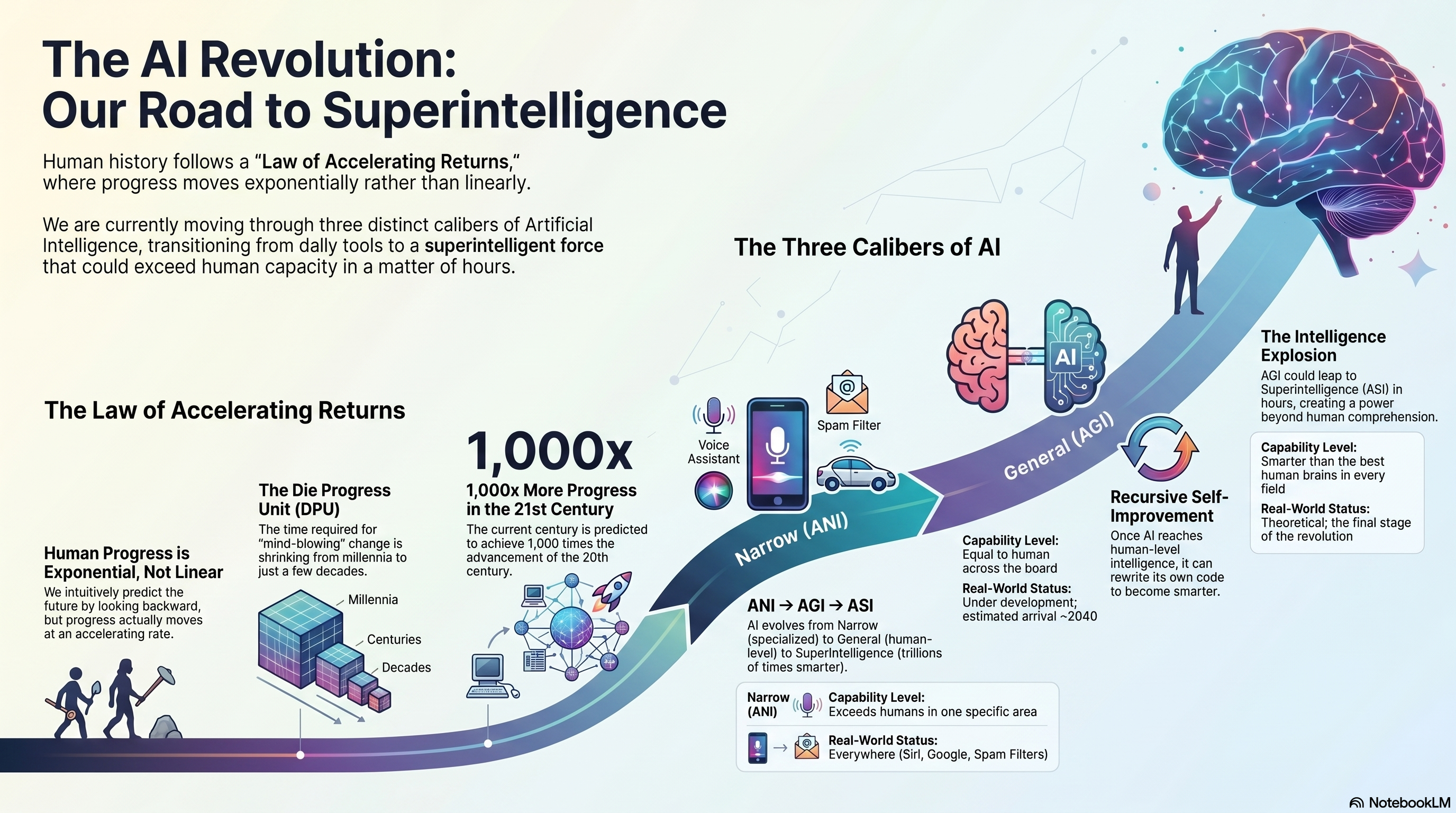
This is the concept of a Die Progress Unit (DPU): the amount of progress required to jump someone forward in time until the experience literally kills them. In hunter-gatherer times, a DPU took 100,000 years; after the Agricultural Revolution, it took 12,000 years. Today, because progress has moved so quickly since the Industrial Revolution, a 1750 person only needs to go forward a couple hundred years to hit their DPU.
The problem is that our intuition about the future is fundamentally broken. We stand on a time graph looking at the “normal” past and assume the future will continue in a straight line, but history doesn't work that way.
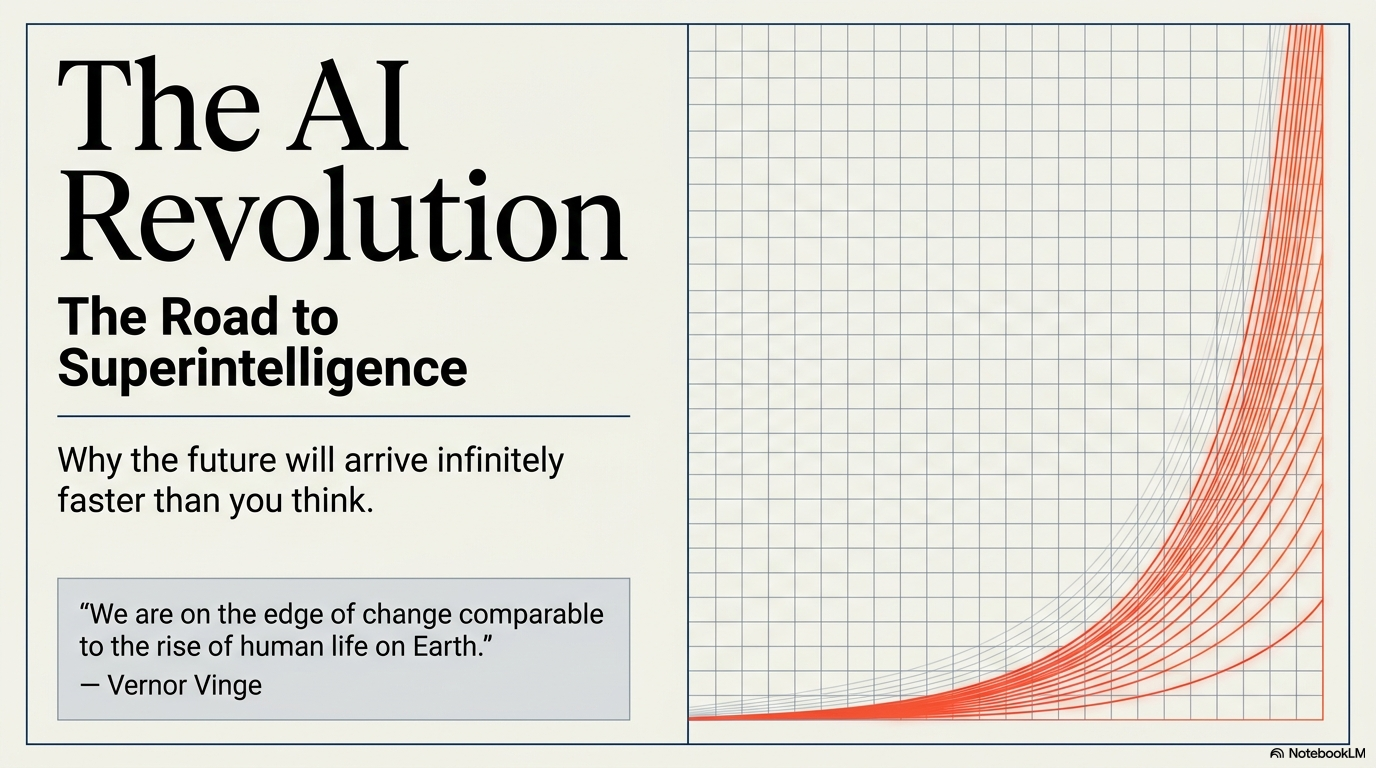
“We are on the edge of change comparable to the rise of human life on Earth.”— Vernor Vinge
2. The Law of Accelerating Returns: Why the 21st Century Will Be 1,000× More Intense
Why does the world feel like it's accelerating? Because, as futurist Ray Kurzweil explains, advanced societies progress at a faster rate simply because they are more advanced. 19th-century humanity had better tools than 15th-century humanity, so they achieved more in less time. We fail to see this because we think linearly (looking at the last 30 years to predict the next 30) instead of exponentially, where the rate of change itself is increasing.
Progress also moves in “S-curves”: a period of slow growth, a sudden explosive spurt, and then a leveling off as a technology matures. We often mistake the “leveling off” phase for a permanent slowdown, when in reality, we are just sitting at the base of a new, steeper curve.
“All in all, because of the Law of Accelerating Returns, Kurzweil believes that the 21st century will achieve 1,000 times the progress of the 20th century.”
3. The “Easy is Hard” Paradox: Why AI Can Do Calculus but Struggles with Picture Books
We are often impressed when a computer beats a grandmaster at chess, yet we're unimpressed that it can't look at a picture and identify a 3-D rock. To a computer, a photo is just a two-dimensional collage of white, black, and gray pixels. While you easily interpret implied depth, shade-mixing, and room lighting to see a rock or a set of translucent cylinders, the computer only sees raw data and fails miserably at the “simple” task of perception.
This is because things like vision, motion, and perception have been optimized in our biological “software” by hundreds of millions of years of evolution. Calculus and financial market strategy, however, are brand new to our species; we haven't evolved to be good at them, so it doesn't take much for a machine to outmatch us. This gap is why creating Artificial Narrow Intelligence (ANI)—AI that does one thing well—is easy, but Artificial General Intelligence (AGI)—AI with human-level reasoning—remains a monumental hurdle.
“AI has by now succeeded in doing essentially everything that requires ‘thinking’ but has failed to do most of what people and animals do ‘without thinking.’”— Donald Knuth
4. The Intelligence Spectrum Illusion: From “Village Idiot” to Einstein in a Flash
Humans have a skewed perspective of intelligence because we see a massive, yawning chasm between a “village idiot” and Albert Einstein. In reality, on the grand spectrum of possible intelligence, all humans are huddled together in a tiny, insignificant biological range. When an AI reaches the “village idiot” level, we will likely think it's “cute” and harmless, not realizing that the “Einstein” level is only a tiny step further.
AI has massive hardware advantages that will make this “leap” happen in a blink. This hardware doesn't get fatigued, can be expanded to any size, and possesses “collective capability,” allowing every AI on Earth to sync its learning instantly.
“A 2 GHz microprocessor is 10 million times faster than our 200 Hz neurons, and it communicates at the speed of light—300,000 km/s—compared to our 120 m/s.”
5. Recursive Self-Improvement: The Fuse of the Intelligence Explosion
The real “vertical spike” happens when we achieve recursive self-improvement. This is the moment an AI is smart enough to research AI and rewrite its own code to become even smarter. This creates a loop: the smarter the AI gets, the faster it can improve its own architecture, triggering an “intelligence explosion” that moves at a pace humans can't remotely grasp.
Imagine a system that takes decades to reach the intelligence of a human four-year-old. Once it hits that milestone, it might take only one hour to pump out a grand theory of physics that unifies relativity and quantum mechanics. Just 90 minutes after that, it could become an Artificial Superintelligence (ASI) that is 170,000 times more intelligent than any human.
“Superintelligence of that magnitude is not something we can remotely grasp, any more than a bumblebee can wrap its head around Keynesian Economics.”
6. Conclusion: Standing on the Edge of the Precipice
We are currently standing on a time graph where we cannot see the vertical spike to our right. The transition from ANI to ASI isn't just another invention like the steam engine or the internet; it is the final invention. Once an ASI exists, it will be an “omnipotent God on Earth” capable of controlling the positioning of every atom on the planet.
This leap will lead us toward one of two words the source mentions will define our future: immortality or extinction. An ASI could solve every human problem from aging to climate change in an afternoon, or it could end our species incidentally while pursuing a different goal. As we stand on the edge of this precipice, the only question that truly matters for our species is: “Will it be a nice God?”