The $13,500 Summer That Started It All: The 1955 Dartmouth AI Proposal
A study companion to Phase 1, Week 2 — built around the August 1955 proposal that named the field “artificial intelligence” and launched the 1956 Dartmouth Summer Research Project. Listen to the audio overview, page through the briefing deck, study the infographic, and read the synthesis below.
♪ Audio overview
▤ Briefing deck
◷ Infographic
✎ Written synthesis
1 · Introduction: The Audacity of a New Frontier
In the silent, air-conditioned cathedrals of modern data centers, we find an industry currently valued in the trillions, powered by chips capable of trillions of operations per second. But the lineage of this silicon revolution traces back to a far more modest setting: the summer of 1956 at Dartmouth College in Hanover, New Hampshire. There, amidst the clatter of IBM typewriters and the smell of mimeograph ink, the “Dartmouth Summer Research Project on Artificial Intelligence” was born.
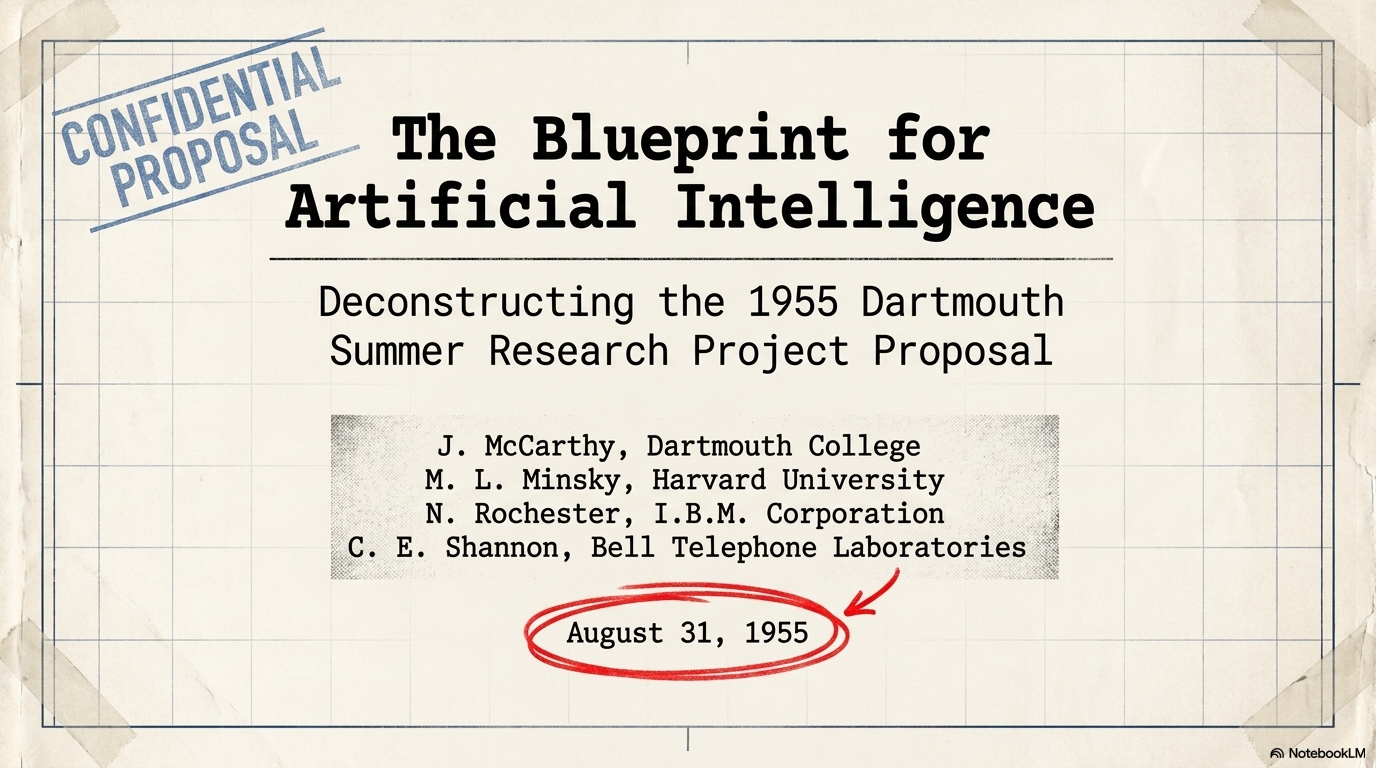
The document that launched the field—a proposal written in August 1955—was not authored by mere dreamers, but by the intellectual titans of the era. There was Claude Shannon, the Bell Labs mathematician who had already fathered Information Theory; Nathaniel Rochester, the man at IBM responsible for the design of the Type 701, the first large-scale scientific computer; Marvin Minsky, a brilliant young Harvard Junior Fellow; and John McCarthy, a Dartmouth mathematics professor. With the quiet hubris typical of the mid-century scientific elite, these men believed they could “solve” the fundamental mysteries of the human mind in a single season.
2 · The Two-Month Timeline: A Case of Historic Optimism
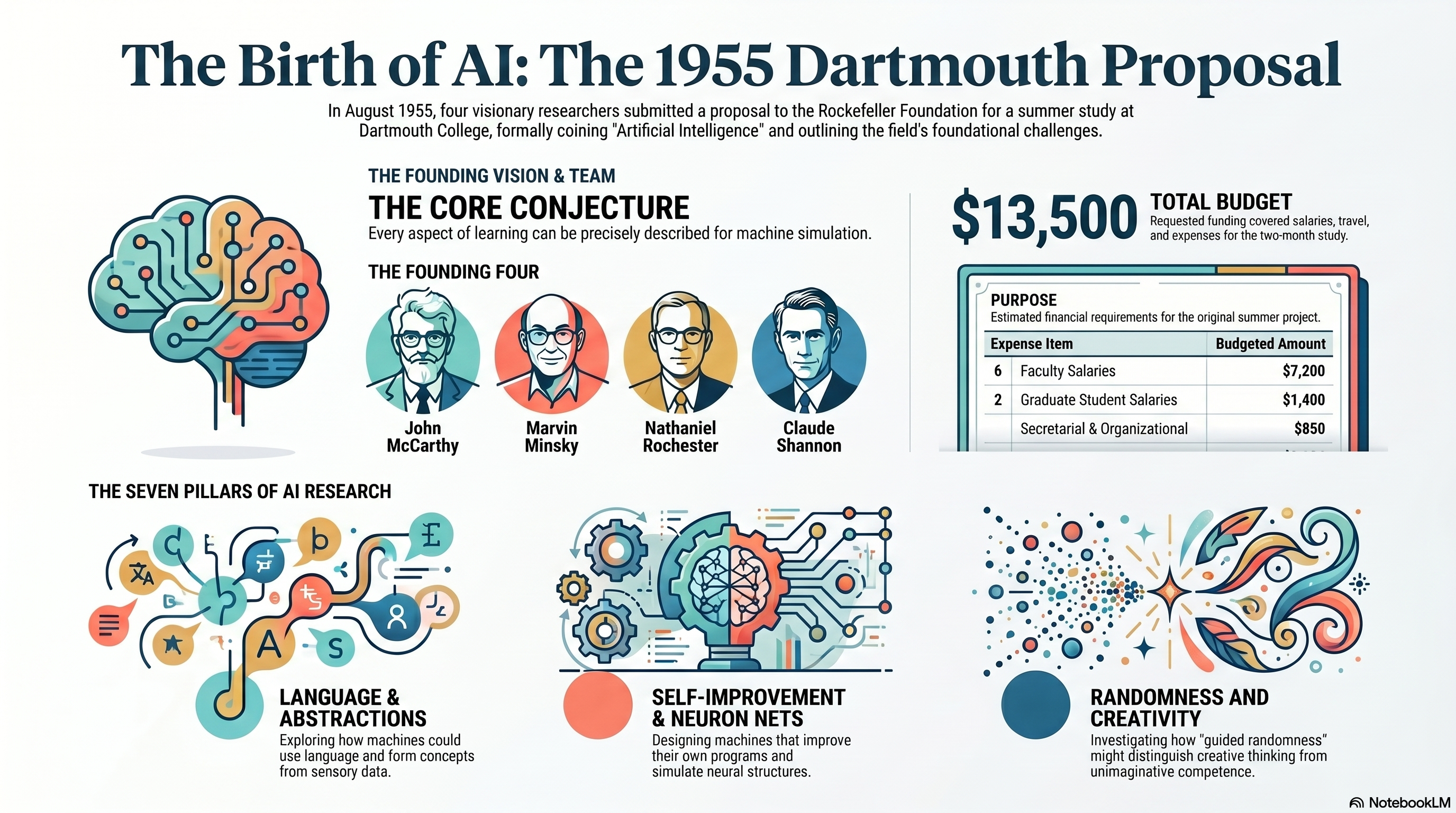
The sheer audacity of the original project scope remains breathtaking. The proposal called for a “2 month, 10 man study,” suggesting that a small group of scientists could spend a summer together and emerge with a blueprint for artificial thought. Their confidence was anchored in a singular, powerful assumption that has served as the field's foundation for seven decades:
The study is to proceed on the basis of the conjecture that every aspect of learning or any other feature of intelligence can in principle be so precisely described that a machine can be made to simulate it.
The hubris lies in that one word: precisely. The founders assumed that the “messy” reality of human cognition—our abstractions, our language, our ability to improve ourselves—could be reduced to a series of neat, formal descriptions. While we are now seventy years into that “two-month” study, this conjecture remains the North Star of the industry. It transformed intelligence from a philosophical mystery into an engineering problem, even if the “description” of that intelligence has proven far more elusive than those ten men anticipated.
3 · The Budget of a Revolution: Starting a Field for $13,500
Perhaps the most startling detail in the 1955 proposal is the cost of initiating a global technological shift. To fund this foundational moment, the organizers approached the Rockefeller Foundation with a request for $13,500. In retrospect, it is the cheapest seed round in history.
The itemized budget from the proposal reveals a world of academic frugality:
- $7,200 for the salaries of six faculty-level participants ($1,200 each).
- $1,400 for two graduate students ($700 each).
- $2,400 for traveling and rent expenses for eight participants.
- $600 for “Additional traveling expenses.”
- $850 for secretarial and organizational expenses (specifically $500 for a secretary and $150 for duplicating).
When contrasted with the billions of dollars currently poured into a single training run for a modern Large Language Model, the return on this $13,500 investment is incalculable. It serves as a poignant reminder that the most significant breakthroughs in technology often begin not with massive hardware, but with the protected time required for brilliant minds to think in concert.
4 · Creativity is Just “Guided Randomness”
While the public often views creativity as a “divine spark” or a “soulful” endeavor, the Dartmouth founders saw it as a statistical problem. In their section on “Randomness and Creativity,” they proposed a theory that feels remarkably prophetic of how modern generative AI operates. They conjectured that “creative” thinking is simply “competent” thinking with the strategic injection of noise.
The authors sought a middle ground between the rigid, slavish rule-following of early calculators and the chaos of pure chance. They explicitly noted that the nearest practical approach to this was an “extension of the Monte Carlo method”—a direct ancestor to the probabilistic sampling used by today’s AI to generate art, poetry, and code.
The randomness must be guided by intuition to be efficient.
In their view, “intuition” was the filter that allowed a machine to sort through random “hunches” to find the useful ones. Today, when we adjust the “temperature” of an LLM to make it more or less creative, we are essentially acting on this 1955 hunch: that brilliance is just randomness, refined by a well-trained model.
5 · The Machine with an Inner Life: Minsky’s “Imaginative” Model
Marvin Minsky, then still early in his legendary career, contributed a vision for a machine that possessed a form of “internal life.” He argued that for a machine to exhibit high-level behavior, it shouldn't just react to the world; it should build “within itself an abstract model of the environment.”
Minsky’s proposal describes what he called “imaginative” behavior: the machine would “explore solutions within the internal abstract model” before attempting any external experiments. This is the direct conceptual forebear to what modern researchers call “latent space” or “world models.”
Most tellingly, Minsky noted that because these internal trials were hidden from view, the machine’s eventual external action would appear “rather clever” to an outside observer. This suggests a profound insight into the illusion of intelligence: that what we perceive as “cleverness” is often just the result of a machine successfully simulating a thousand failures in the silence of its own internal model before presenting us with a single success.
6 · Why English is the Ultimate Code
The most surprising synthesis in the 1955 proposal is John McCarthy’s argument regarding language. While the following decades would see the rise of increasingly complex and rigid coding languages—C++, Python, Java—McCarthy argued that the ultimate “artificial language” should correspond to English.
McCarthy believed English was “universal” because it allowed for “self-reference” and, crucially, for a user to “formulate statements regarding his progress in solving the problem he is working on.” He envisioned a machine that could handle complicated phenomena through “short arguments or conjectural arguments” in natural language.
After seventy years of forcing humans to speak the language of machines, we have finally arrived at the era of “Prompt Engineering.” By using “Chain of Thought” prompting—where we ask an AI to explain its step-by-step progress—we are fulfilling McCarthy’s 1955 vision. We have returned to the idea that natural language isn't just for communication; it is the most efficient meta-language for solving problems.
7 · Conclusion: The Long Road from Hanover
The Dartmouth proposal is a document of extraordinary foresight and staggering optimism. It reminds us that while the “2-month” timeline was an illusion, the questions raised during that New Hampshire summer remain the definitive challenges of our age. We are still grappling with the nature of “self-improvement,” the mechanics of “abstractions,” and the elusive nature of “intuition.”
The path from Hanover has been far longer and more complex than Shannon, Minsky, Rochester, and McCarthy could have imagined. If the founders were here today, they would likely be astonished by the sheer scale of the hardware we have built, but they might be equally surprised by how many of their original hurdles remain. We have built machines that can mimic the “cleverness” of human speech, yet we are still chasing that original 1955 dream: the point where every aspect of learning can be “so precisely described” that the machine truly understands itself.
If they were here today, would they be more surprised by how far we’ve come—or by how much of their “summer study” is still unfinished?